🎭 One Flew Over the Cuckoo’s Nest – A Timeless Masterpiece of Rebellion and Humanity
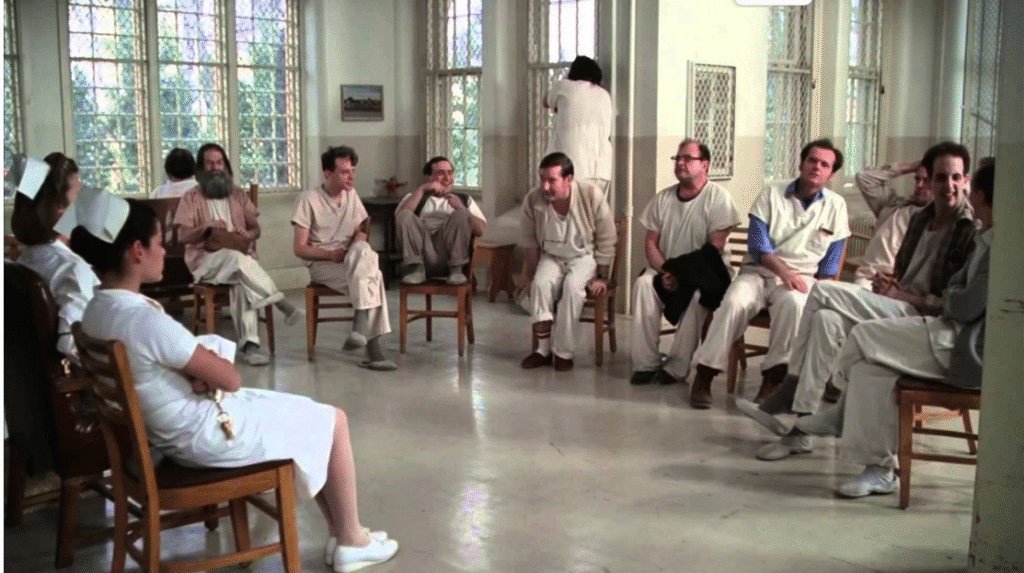
Few films in cinema history have left as profound an impact as One Flew Over the Cuckoo’s Nest (1975). Directed by Milos Forman and based on Ken Kesey’s 1962 novel, the movie explores the thin line between sanity and madness, freedom and control. It stands not only as a triumph of storytelling but also as a searing critique of institutional power and conformity. With its unforgettable performances and emotional depth, the film continues to resonate with audiences nearly five decades after its release.
At its core, the story follows Randle P. McMurphy, played masterfully by Jack Nicholson, a rebellious man who fakes insanity to escape prison labor and ends up in a mental institution. What begins as a mischievous attempt to outsmart the system turns into a life-altering experience — not just for McMurphy, but for the patients he meets. Inside the hospital, he confronts the icy, authoritarian Nurse Ratched (played by Louise Fletcher), whose control over the ward symbolizes the oppressive forces that crush individuality and freedom.
McMurphy’s arrival disrupts the routine of the institution. His loud laughter, card games, and spirit of defiance inject new life into a group of patients who had long been subdued by fear and medication. Each character — from the gentle, stuttering Billy Bibbit to the silent, observant Chief Bromden — represents a fragment of human vulnerability. Through McMurphy’s irreverence, they begin to rediscover a sense of dignity and self-worth that had been taken from them by the system.
However, beneath the humor and chaos lies a deep tragedy. Nurse Ratched, with her calm demeanor and manipulative control, embodies the cold machinery of institutional power. Her ability to humiliate, punish, and manipulate the patients under the guise of “therapy” makes her one of cinema’s most chilling villains. The power struggle between McMurphy and Ratched becomes the emotional core of the film — a battle between individuality and authority, chaos and order, humanity and dehumanization.
Visually, One Flew Over the Cuckoo’s Nest achieves a raw, documentary-like realism. Forman’s direction captures the confined space of the hospital with an almost claustrophobic intimacy. The use of natural lighting and long takes gives the film a sense of authenticity rarely seen in the 1970s. The sterile, controlled environment of the ward contrasts powerfully with McMurphy’s wild, untamed energy, symbolizing the clash between freedom and control. This visual storytelling elevates the film beyond a simple drama into a haunting social commentary.
The performances remain legendary. Jack Nicholson delivers one of cinema’s greatest portrayals — charming, reckless, compassionate, and tragic all at once. Louise Fletcher’s Nurse Ratched is equally unforgettable; her quiet menace and emotional manipulation create a villain not of violence, but of psychological domination. The supporting cast, many of whom were real patients or newcomers, bring a heartbreaking authenticity to the story, making every moment feel painfully real and human.
When the film was released, it struck a chord around the world. It swept the 1976 Academy Awards, winning all five major Oscars — Best Picture, Best Director, Best Actor, Best Actress, and Best Screenplay — a rare feat shared by only two other films in history. But beyond its awards, One Flew Over the Cuckoo’s Nest became a cultural milestone, inspiring conversations about mental health, individuality, and the dangers of blind obedience to authority. It challenged audiences to rethink what it means to be “sane” in an insane world.
Nearly fifty years later, the film’s message remains as relevant as ever. In an age of systems, surveillance, and social conformity, McMurphy’s laughter and defiance still echo as a cry for freedom and compassion. One Flew Over the Cuckoo’s Nest is not just a film — it’s an experience, a reflection of the human spirit’s resilience against control. It reminds us that true madness lies not in rebellion, but in surrendering our humanity to the comfort of conformity.